
Scroll any feed on any given week and something becomes immediately visible. Not variety, not the infinite diversity platforms promise, but convergence.
One week, every second video is a Bruce Lee AI recreation. The week before, thousands of creators narrating the same arc in the same sequence. The specifics rotate. The structure does not.
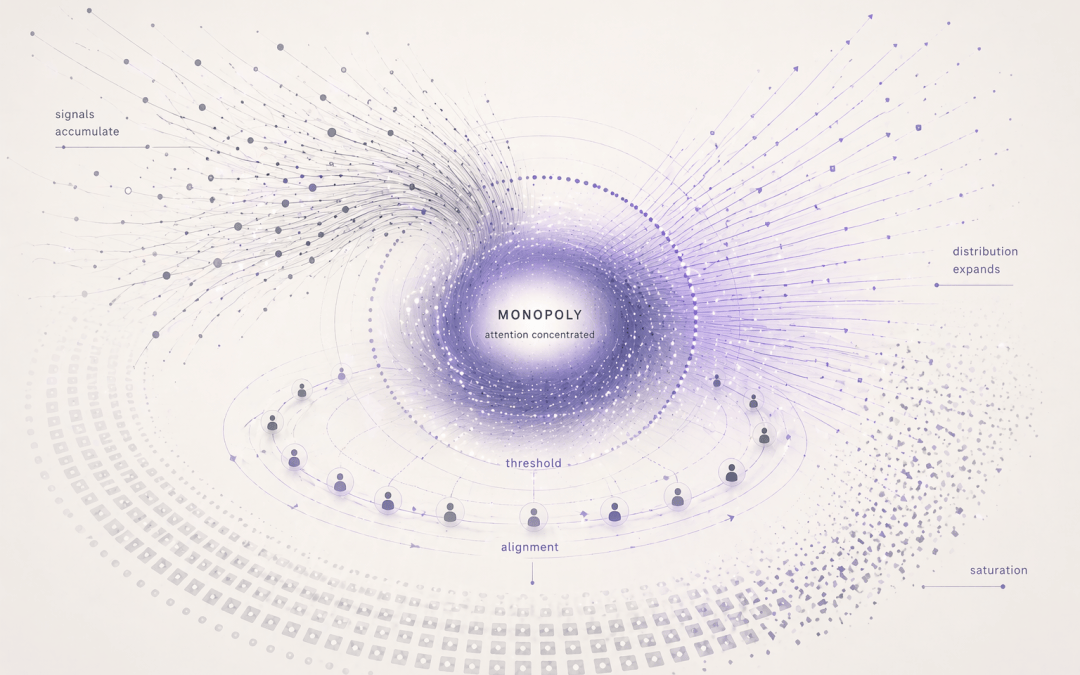
This is attentional monopoly: the temporary capture of feed distribution by a single content signal, produced not by editorial decision or coordinated effort, but by the architecture operating as designed.
The question is not why one thing trends. The question is why the feed produces almost nothing else while it does.
Attentional monopoly is not an exception. It is what the feed defaults to when its conditions are met. Those conditions recur constantly.
How Attentional Monopoly Begins
It begins before the viewer decides anything.
A pause in the scroll. A second viewing without a like or share. These are not declared preferences. They are behavioral residue — the involuntary trace of attention. The system reads them as signal.
When that residue clusters — the same content type accumulating the same response across enough viewers within a short interval — it crosses a threshold. Distribution reallocates toward others predicted to respond similarly.
Attentional monopoly forms at that threshold. What follows is execution.
The state sustains without intervention. It persists until the same viewers who contributed to formation begin registering the format as familiar rather than arresting. As that shift accumulates, the signal weakens and the monopoly contracts.
Why Output Aligns
Creator behavior within a monopoly is often described as imitation. The pattern does not require it.
Creators share visibility into the same performance signals — relative velocity, completion, and response patterns tied to the current dominant format. These signals are surfaced directly by the platforms.
When a format enters monopoly, that condition is legible. Independent creators read the same signals and arrive at similar production decisions at roughly the same time.
No coordination is required. Alignment emerges from shared inputs.
The output appears synchronized. The cause is structural.
Initiation Without Intent
A third actor participates without recognizing participation.
The viewer does not intend to initiate anything. A brief pause, a partial rewatch, a slightly extended dwell time — these actions do not register as preference to the viewer.
Aggregated across many viewers, they function as instruction.
Involuntary attention becomes system input. The system executes on it. Creators respond to that execution.
The sequence forms without deliberate choice at any point.
System State: What the Feed Becomes
During a monopoly, the feed manages to be personalised and homogeneous at the exact same time.
It is personalised because selection is based on individual behavioral signals. It is homogeneous because those signals converge across large populations, producing a single dominant distribution outcome.
Content outside the dominant signal remains present but receives less distribution. Visibility concentrates within the monopoly.
Creators operating outside it experience contraction in reach. Many adjust output toward the dominant format. This alignment reinforces the existing state and accelerates the formation of the next.
Attentional monopoly does not eliminate diversity. It reduces its visibility while the state persists.
This produces the appearance of discovery: a feed that seems responsive and varied, while distribution is in fact concentrated around the most recent signal threshold.
The feed does not collapse into one thing by accident.
It concentrates because the system is built to detect where attention accumulates and allocate distribution accordingly. Because creators respond to those allocations. Because viewer behavior is read as signal whether intended or not.
No coordination is required. No external decision is necessary.
This is not how trends form. It is how feeds operate.
Attentional monopoly is continuous. Variation appears in the intervals between instances of it.